
Put AI inside workflows your team can review and control
AI can help with a defined step in a business process, such as extracting information from a
document, classifying an incoming request or preparing a draft for review. The hard part is making
sure the right data is used, a person can check the result, exceptions reach the right owner and the
process leaves a record people can follow.
KPOData works with UK organisations to configure AI-assisted steps inside business workflows. We
agree what the AI is allowed to do, where human review is required, how exceptions are handled and
what information the deployed workflow records. The solution is scoped around your process and
existing systems.
Where a controlled workflow helps
A workflow may be worth reviewing when staff are already using AI informally, when a manual
process has a clear repeatable step, or when teams need a better way to review AI-assisted work.
Examples include document intake and extraction, classification and routing, preparing a first
draft, summarising supplied records, or assembling information for a human decision.
KPOData does not decide whether a proposed AI use is lawful or appropriate for your organisation.
Your process owner, data protection lead, security team and other advisers set the requirements.
We help translate approved requirements into a working process, application and evidence design.

Keep the workflow bounded
A controlled AI workflow separates the parts that should be predictable from the part that uses
AI. The workflow can validate inputs, apply fixed business rules, send an approved task to an AI
service, present the response for review, and route exceptions for a person to resolve.
The AI can assist with a defined task. The customer decides whether it can recommend, draft,
classify or take any action, and which decisions must remain with an authorised person. We
design the solution around those boundaries rather than assuming that every AI response is
correct or that every process should be automated.
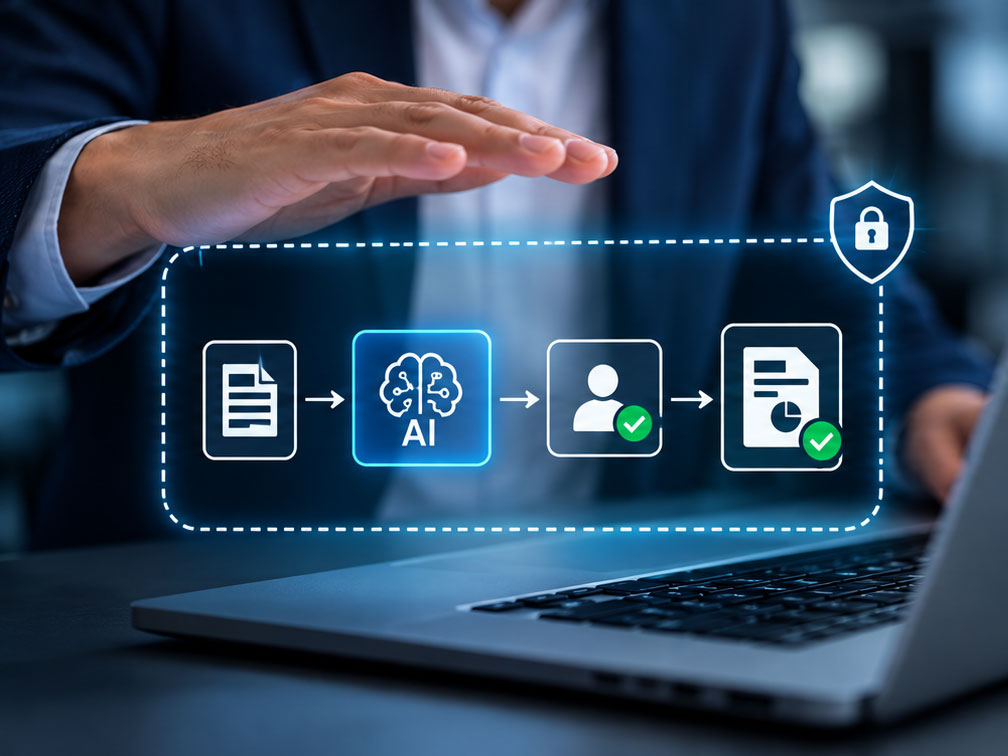
Controls agreed for the use case
Depending on the project, the workflow design may define:
- the process owner, permitted use and approved users;
- the data the workflow may collect or pass to an AI service;
- the prompt or task instructions and the location of AI-generated output;
- required review, approval, escalation and override steps;
- validation rules, exception paths and actions that are blocked until approval;
- what events, decisions and changes need to be recorded;
- the system integrations, hosting arrangements, access roles and retention requirements.
The deployed controls and evidence depend on the agreed design. KPOData will confirm the
available product behaviour, integration and logging scope during discovery. We do not describe a
workflow as compliant, audit-proof or tamper-proof merely because it uses KPOData.
How delivery works
outcomes.
decisions.
requirements with your accountable team.
cases, access boundaries and failure paths with nominated users.
agree how changes are requested, tested and released.
Extend or migrate selected workflows
KPOData can assess a defined workflow that currently runs in an enterprise platform. For workflows
that fit the platform’s configurable model, our team can build forms and workflow steps and connect
systems through APIs. This can support a genuine migration of selected operational work, not only an
AI layer alongside the current system.
Depending on the process and technical fit, the right option may be to keep it where it is, extend it
through an integration, or migrate the workflow to a KPOData application. We map users, data, rules,
permissions, integrations, history, support and change ownership. We do not claim one-for-one parity
with an entire enterprise suite or recommend moving every process. Migration scope is agreed
application by application after fit and operating requirements are checked.

UK legal and governance context
There is no single general UK AI law that makes a workflow automatically compliant or non-compliant.
Existing obligations depend on the organisation, the use case and the data involved. Where personal
data is used, UK data protection requirements may apply. Your organisation remains responsible for
determining its obligations and approving the control design.
KPOData can help implement agreed workflow controls and collect evidence. We do not provide legal
advice, certify compliance or replace your internal governance, risk, data protection or security
review. If your organisation or AI system has EU operations, ask your advisers whether EU AI Act
duties also apply.
Who this is for
This work is most relevant to financial services, professional services and other regulated or
data-intensive teams that have a defined process, an accountable owner and a practical AI use case
to assess. Typical stakeholders include operations, risk, compliance, technology, data protection
and information security.
Frequently asked questions
Can KPOData prevent employees from using unapproved AI tools?
KPOData builds workflow applications; it is not an endpoint monitoring or enterprise AI discovery
product. It can implement an approved intake, review or workflow process, but it does not by
itself discover every AI tool employees use.
Does KPOData decide whether an AI use is compliant?
No. Your organisation and its advisers determine whether a use is appropriate and what
obligations apply. KPOData can implement agreed workflow controls and evidence requirements.
Can AI-generated work require approval before it moves forward?
A workflow can be designed to route AI-assisted output to an authorised reviewer before a later
step proceeds, subject to the configuration and integration agreed for the deployment.
What evidence can the workflow keep?
The record is defined during discovery. It may include selected input references, workflow
status, the AI task or prompt configuration, review actions, approvals, exceptions and changes,
where the deployed solution supports them. Confirm events, retention and export before relying
on them.
Can KPOData replace ServiceNow?
KPOData has configurable forms, workflows and API connections that may support migrating selected
ServiceNow processes. We assess each application and workflow for functional, data, integration
and operational fit. KPOData is not presented as a drop-in replacement for every part of the
ServiceNow suite; some capabilities may be retained or integrated.
Does KPOData offer a self-service AI governance product?
No. KPOData’s current model is service-led: the team works with you to define, configure, test
and support a workflow application.
Start with one process
Tell us what the process does today, where AI may help, which systems are involved and what a
reviewer must be able to check afterwards. We will assess fit and identify the product, integration
and evidence questions to resolve before proposing a build.
